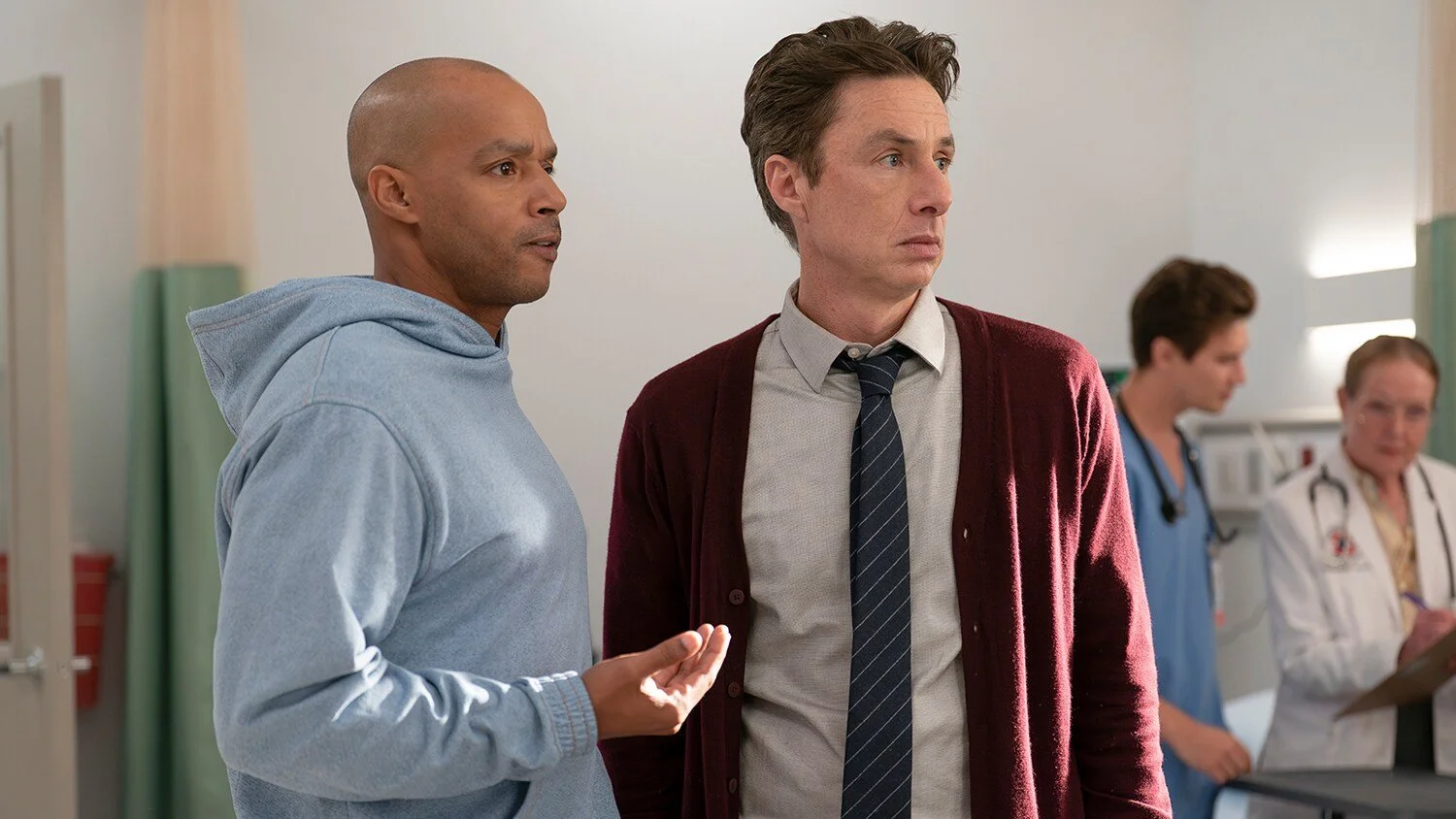
Donald Faison and Zach Braff in Scrubs. © Disney. Publicity image.
Spoilers through “My Halloween,” the October 28, 2026 episode of the Scrubs revival.
J.D. climbs onto Turk for another ride down the hospital hallway. The bodies remember the joke. Turk’s back has other plans.
The revival’s early reunion ends with sciatica and a tumble, a small indignity described in the Associated Press’s cast interview. It could have been an easy gag about getting old. It also contains a surprisingly good answer to the problem of bringing an old show back. These men still know how to be ridiculous together. Keeping that part of themselves has become a little more complicated.
The Scrubs revival works because it lets its characters need each other differently. J.D., Turk and Elliot have become the people somebody else looks to for help. Their old relationships have to stretch around that responsibility. The comfort comes from discovering that the affection can survive the change.
That is a much more generous promise than getting our twenties back.
The problem with TV revivals is the promise of standing still
A familiar hallway can do a lot of emotional work before anyone speaks. We recognize the place, anticipate the joke, remember the person we were when we first watched. A revival gets that feeling almost for free. Then it has to decide what to do with it.
The temptation is to keep returning to the moment of recognition. Bring back the prop. Repeat the argument. Let the characters make the same mistakes, because those mistakes are part of what we remember loving. Eventually, affection can start to feel like a job the audience is doing for the show.
Scrubs has an advantage here: its central relationships were built around people learning how to care for others. There is no age at which that becomes a finished assignment.
In TVLine’s September interview with the cast and creators, Bill Lawrence explains that giving the returning doctors their old youthful problems would have defeated the revival. J.D., once shaped by everyone around him, now has to help shape other people. The familiar character becomes interesting again because his position in the room has changed.
This is also where the comparison with less satisfying revivals becomes useful. A reunion asks whether we still love these people. An ongoing story has to ask something they cannot answer yet. For Scrubs, that question is what happens when the person still waiting to feel like a grown-up is already somebody else’s grown-up.
J.D. and Elliot’s divorce leaves room for a different kind of love
Splitting up J.D. and Elliot risks feeling like the most mechanical kind of revival storytelling: dismantle the ending so the old romantic machinery can run again. Anyone attached to that ending has a fair reason to resist it.
What makes the choice worth considering is the relationship the show builds afterward. In the first season’s third episode, Elliot breaks down in a bathroom and insists that losing the marriage cannot mean losing J.D. as her friend and family. Showrunner Aseem Batra told TVLine that the writers wanted to move beyond the possessive behavior of J.D.’s twenties rather than repeat it.
The important change is in what love asks of them. Getting the other person back is no longer the only imaginable expression of it. They have to work together. Raise a child. Allow a shared life to keep existing in a shape neither of them originally chose.
That can be more emotionally difficult than a grand reunion. It asks whether years spent loving someone still count when they do not produce the ending you expected. Scrubs makes room for the answer to be yes.
It also leaves room for discomfort. The divorce does reopen dating plots, and its specific causes were left unresolved in the revival’s first season. The decision has to keep earning its place. But the bathroom conversation gives it a purpose beyond clearing the board for another romance: these people are trying to preserve something without pretending it stayed the same.
Dr. Cox becomes the person who needs help
The clearest reason to bring Scrubs back arrives at a hospital bedside.
In “My Odds,” Cox collapses and is diagnosed with microscopic polyangiitis. He asks J.D. to keep him alive and admits that he is frightened. Zach Braff discussed the scene with The National, describing the unexpected emotion of filming that exchange with John C. McGinley.
For years, Cox’s competence made him the person J.D. could turn toward when the room became frightening. Now J.D. has to stay in that room for him.
The old relationship is still there. That is why the reversal carries so much weight. We understand how much it costs Cox to ask, and how much the request means to the man who once wanted his approval. Becoming capable has brought J.D. closer to his mentor’s vulnerability rather than safely beyond his own.
This is one of the stranger experiences of getting older: the person who taught you what to do can become the person waiting for you to do it. You do not suddenly stop feeling like their student. You help anyway.
Season 2 carries that responsibility beyond the bedside revelation. As Batra explained after the premiere, Cox’s medical progress is followed by the financial complications of chronic illness. Treatment is not a neat ending. There is paperwork after the emotional speech.
And in October 28’s “My Halloween,” the consequences reach his retirement. TVLine’s episode recap documents Cox working as a concierge doctor because his medical bills have made the retirement he planned unaffordable. He has returned to work out of necessity.
There is something particularly sharp about that choice in a revival. The audience gets someone back. The character has lost something to make the return possible. Scrubs allows both feelings to occupy the same hospital.
Friendship gets harder when you are responsible for the room
J.D. and Turk can still be each other’s favorite idiot. The show also puts them in situations where being a good friend and being a good boss pull in different directions.
In “My Chief,” which aired October 14, J.D. discovers a costly mistake by Turk and faces the decision of whether to report it. That conflict is the premise of ABC’s official episode description. Their friendship now exists inside a responsibility that reaches beyond the two of them.
That is fertile ground for a continuation. The history between them makes the decision harder, not unnecessary. Twenty years of affection cannot do the thinking for you. Sometimes it makes you the least objective person available.
The same shift is present in the mentoring stories. “My Mentee” puts J.D.’s insurance workaround in conflict with his new mentee. Experience has given him authority, but authority does not make every instinct right. New doctors need to be people who can complicate his thinking, rather than an audience assembled to admire a returning favorite.
A revival becomes a living show when its new characters can inconvenience its old ones.
Nostalgia can be warm without trapping everyone inside it
None of this requires Scrubs to become solemn. The possibility of a ridiculous fantasy or a stupid joke is part of the relief. Adulthood has enough places where being taken seriously means sanding away every strange little thing about yourself.
The revival offers a different possibility. You can take somebody’s care seriously and still be a fool with your best friend. You can be older, divorced, frightened or exhausted without becoming only those things.
There is a connection here to the distinction between nostalgia and hope in my essay on millennial optimism. Remembering what felt good can help us recognize what is still worth making room for. It becomes limiting when the past is the only place we allow those feelings to live.
Scrubs is not immune to that trap. Familiar faces are part of its appeal, and some callbacks will always work better than others. Batra has also acknowledged that the short first season sometimes gave characters moments when they needed fuller stories. A successful return still needs room to become an ordinary, imperfect television show.
But its strongest choice is already clear. It gives the years between episodes somewhere to go. Into the marriage that changed. Into the friend whose body hurts. Into the mentor who has to ask for help.
We may arrive wanting everyone to be where we left them. There is something warmer waiting when they are allowed to move.
The hallway is familiar. This time, someone else needs you to walk down it.
For more essays about the human stories inside film, television and games, find me on Instagram.
Scrubs season 2: official trailer from ABC.