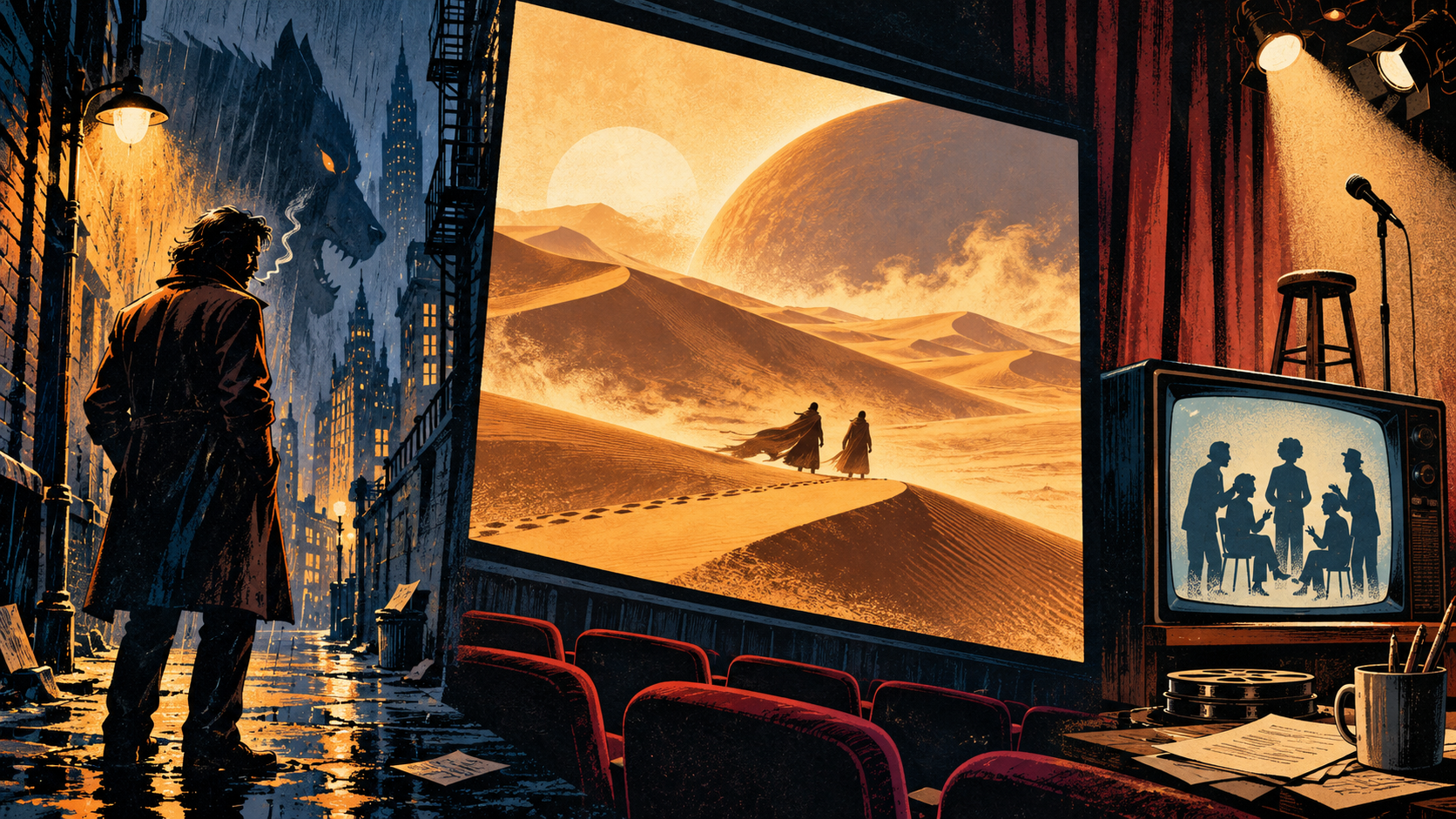
A return can be more interesting than a reset. Sometimes the reason to revisit a familiar story isn't that we miss the wallpaper. It's that there's something unfinished inside it: a decision we made, a change we didn't quite notice, or a creative partnership worth understanding.
For October 29, 2026, three entertainment developments stand out through that lens: The Wolf Among Us Remastered launches today, Dune gets an IMAX double feature in November, and Netflix's SCTV documentary arrives tomorrow. These aren't three versions of the same nostalgia pitch. Each offers a different reason to look again.
The Wolf Among Us Remastered launches with choices that carry forward
Telltale and PM Studios launched The Wolf Among Us Remastered worldwide on October 29, 2026, digitally for PC through Steam and the Epic Games Store, PlayStation 5, and Xbox One, with backward compatibility on Xbox Series X|S. Nintendo Switch versions will follow later. The publishers' launch announcement also confirms that defining choices can carry into The Wolf Among Us 2 through a Telltale account.
That last detail is the interesting one. A remaster usually asks whether a game can look better. This one is also asking what should survive the trip.
Bigby Wolf is a fairy-tale monster working as a sheriff, trying to keep a hidden community safe while investigating a murder. The tension is built into the job description: can someone known for being dangerous become someone other people can trust? Carrying decisions forward gives that question a longer life. Returning to Fabletown isn't only a chance to recognize the streets. It's a chance to bring your version of Bigby with you.
There are additions to explore, including five playable deleted scenes presented as special features and an optional black-and-white Noir Mode. But the continuity matters more than the extra shelf space. A choice-based story feels different when the next chapter doesn't simply wipe the slate clean.
Importantly, newcomers won't need a previous playthrough: Telltale says players can establish their past choices at the beginning of the sequel. That's a thoughtful distinction between remembering your audience and making everyone do homework. It connects with the question behind my look at Rememorex's collaborative storytelling: what changes when the audience has a real hand in the story?
Dune's IMAX double feature makes room for the whole journey
IMAX lists a Dune: Part One and Dune: Part Two double feature for November 13, 2026, with an exclusive sneak peek at Dune: Part Three. The official event page gives the program a running time of five hours and 32 minutes. Check local listings rather than assuming every IMAX location is participating.
The preview is the obvious attraction. The double feature itself is the more interesting storytelling proposition.
A recap can remind you where a character ended up. Sitting with two films gives you the time between the beginning and that ending. Those are different things. In its original production synopsis for Part Two, Warner Bros. describes Paul joining Chani and the Fremen while pursuing revenge for his family, facing a choice between love and a much larger destiny. That's older plot context, not a new announcement, but it explains why the pairing has value beyond screen size.
Personal loss and enormous power sit on the same path. Watch that path in one stretch, and the small human reasons behind the spectacle have less room to disappear from memory. The boy who lost his family doesn't become irrelevant just because the story grows bigger around him.
Five and a half hours is a substantial commitment, and it won't suit everyone's schedule. Still, there's something welcome about a theatrical event built around giving a story more time rather than compressing it into a reminder. The new footage points toward the next chapter. The films beside it ask us to pay attention to how we got there.
Netflix's SCTV documentary lets the comedians help choose the memories
SCTV: The Greatest Show You've Never Heard Of, directed by Jason Hehir, premieres on Netflix October 30, 2026. This is a release-eve spotlight, not a newly announced project: Netflix outlined the documentary in its October 7 comedy-documentary announcement. It brings together cast interviews, archival material, and a Toronto reunion to revisit the Canadian sketch-comedy series.
The detail that makes this more than a familiar-name roll call is how Hehir approached the sketches. He asked the surviving cast members which ones they wanted included and tried to honor their selections.
That's a lovely starting point for a documentary about creative work. The sketches that travel furthest aren't necessarily the ones their makers hold closest. Giving the performers a say makes room for another kind of memory: the odd little idea that mattered inside the room, not just the clip that kept circulating outside it.
It also shifts the question from “Remember these people?” to “What did they make together?” A comedy ensemble isn't simply a row of future careers. It's people learning each other's timing, recognizing an opening, and trusting somebody else to take the joke somewhere unexpected. The documentary's cast-selected material offers a concrete way into that relationship without needing to turn affection into a ranking.
Across all three stories, the worthwhile return isn't the one that promises nothing has changed. It's the one that gives us a clearer sense of what deserves to come along. For more conversations about familiar stories and the people inside them, you'll find me on Instagram at @joeypedras.