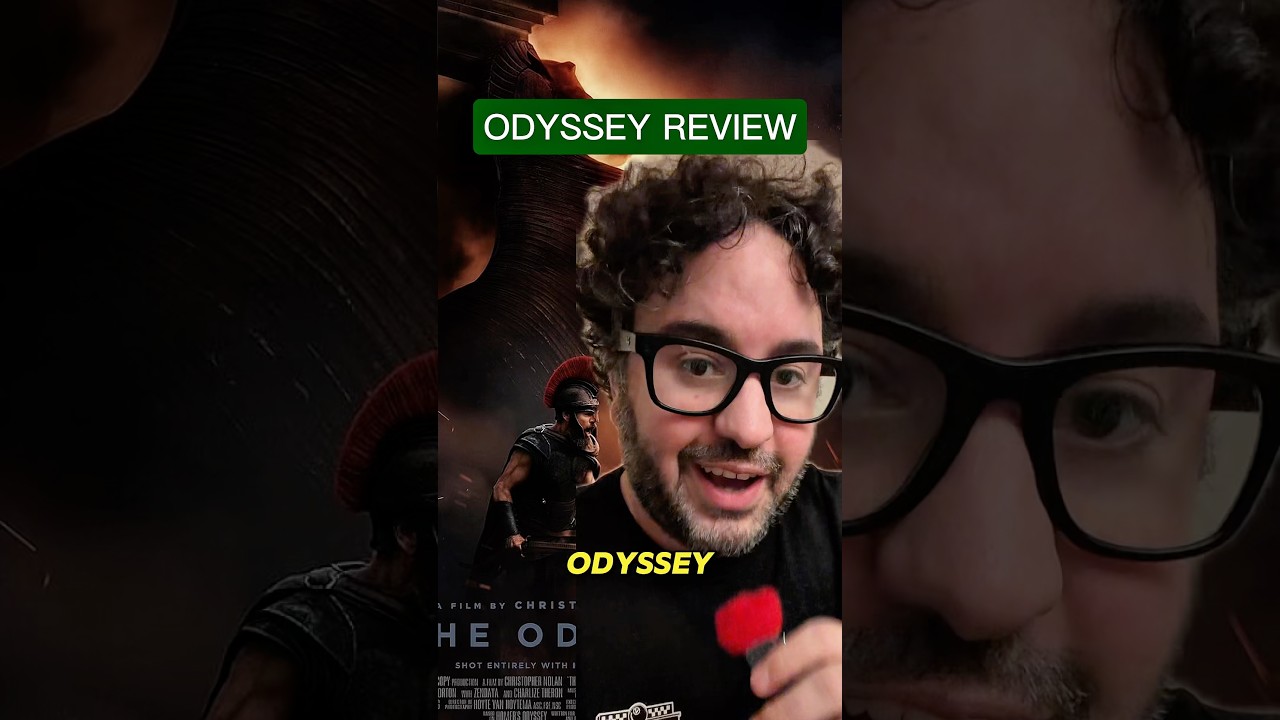
My The Odyssey review comes down to this: Christopher Nolan has turned Homer’s epic into a vast, frightening film about what war does to everyone caught in its wake. I watched it in 70mm and left convinced that Nolan has made his best film. The scale is enormous, but the real achievement is emotional. Matt Damon, Anne Hathaway, and the ensemble make the myth feel bruised, angry, and painfully human.
Spoiler note: This review names a few major set pieces, including Troy and Circe, but does not discuss the ending or reveal how Nolan reshapes the final stretch.
TL;DR
- Verdict: I loved it and gave it 5 out of 5.
- Best quality: It makes Odysseus’s journey feel like an unrelenting horror story.
- Standouts: Matt Damon surprised me, while Anne Hathaway nearly stole the film.
- Format: See it on the largest film screen available, ideally IMAX 70mm if you can.
Is The Odyssey worth seeing?
Yes. If you like filmmaking on a grand scale with real emotion underneath it, The Odyssey deserves a theater. Its images are massive, but the reason it lands is the pain inside them.
The easiest way to sell this movie is to list the spectacle. The invasion of Troy. The Trojan horse. The open sea. Circe. Gods, monsters, armies, and ships. All of it looks gorgeous. Yet a list like that misses what made the film special for me.
Nolan does not stage Homer as a parade of famous episodes. Every encounter feels like another turn of the screw. The official site calls the film a “mythic action epic,” and that is accurate, but it is only half the description. This is also a film about people trying to survive what the war has left inside them. Universal’s official synopsis and cast page confirms the July 17, 2026 release, Nolan’s writing and directing credits, and the central ensemble.
That is the practical takeaway: go for the scale, but expect the emotional damage to stay with you longer than the action.
Why does The Odyssey feel like a horror film?
Nolan treats the voyage as exposure to one terror after another. The sea offers no safety, home offers no peace, and every new place can become a trap before anyone understands its rules.
This was the part that floored me. I have seen adaptations focus on adventure, cleverness, or the clean shape of the hero’s journey. This version understands how terrifying the story is. Odysseus is not moving through a friendly fantasy world. He is crossing vast spaces where the normal rules can disappear without warning.
The openness matters. The sea, the coastlines, and the battlefields are expansive enough to make a person look helpless. Nolan uses that physical scale like a horror director uses a dark hallway. You can see farther, but that only shows you how little protection exists.
The fear is not limited to the voyage. It is waiting at home too. Everyone is living inside a different version of the same wound, shaped by absence, uncertainty, anger, and grief. That parallel is already central to Homer’s poem, where the suffering at sea and the crisis in Ithaca develop together. The film makes both sides feel immediate.
“The Odyssey” works because the monsters are not interruptions. They are part of a world where nobody has escaped the war untouched.
That is why the film felt less like a grand adventure to me and more like an ordeal. It is myth presented as sustained psychological pressure.
Do the casting and dialogue work?
They worked for me. Lines that felt stiff or overly formal in the trailers gain weight inside full scenes, and the famous cast feels chosen for emotional precision rather than name recognition alone.
I went in aware of the complaints about the casting and dialogue. I did not have the same problem once the movie started. The language belongs to a heightened world, but the actors keep it attached to recognizable feelings. Fear, resentment, hope, and exhaustion move through the dialogue even when the words sound ceremonial.
Anne Hathaway is the clearest example. A few of her trailer lines had struck me as odd when separated from the scene. In the finished film, they land. She understands the pressure beneath the language, so a line that might look theatrical on the page becomes intimate and raw.
The casting also has a structural purpose. Nolan moves through large spaces and complicated situations quickly. He needs actors who can communicate a full private history in a look, a pause, or a short exchange. The official cast includes Damon, Hathaway, Tom Holland, Robert Pattinson, Lupita Nyong’o, Zendaya, and Charlize Theron. That is a lot of star power, but the film uses it to create instant emotional clarity.
The takeaway is simple: judge the dialogue inside the scene, not inside a trailer cut. Context changes the temperature of almost every line.
How good are Matt Damon and Anne Hathaway?
Both are excellent. Hathaway delivers the film’s biggest surprise, while Damon gives Odysseus enough force to command the frame and enough damage to make the long journey feel physically and emotionally costly.
Hathaway blew me away. Her performance is layered with emotions that pull against one another. She can show love, anger, hurt, and disbelief without turning a scene into a speech about any one of them. I would put this among the best work of her career.
Damon surprised me for a different reason. I have always liked him, but I have never been a hardcore Matt Damon person. Outside of The Martian, this may be my favorite performance from him. His Odysseus does not feel like a clean mythic icon. He feels like a man forced to keep functioning after the world has taken pieces out of him.
That distinction matters. Strength alone would make the role flat. Damon gives the film authority, but he also gives it fatigue. You believe this man can lead others, and you believe every decision is adding another weight he will have to carry home.
Their performances prove the larger point about the ensemble: each person is feeling a different version of the same catastrophe for a different reason.
Should you see The Odyssey in IMAX 70mm?
If IMAX 70mm is available and practical, that is my first choice. The movie will still work elsewhere, but its landscapes, bodies, and threats are designed to overwhelm your field of view.
I saw the film in 70mm, and the format made the world feel open, textured, and frighteningly physical. The official movie site says the production was shot entirely with IMAX film cameras, while IMAX describes it as the first feature shot entirely with IMAX film cameras. In other words, the large-format presentation is not a late marketing add-on. It is part of how the movie was conceived.
| Format | Best for | My take |
|---|---|---|
| IMAX 70mm film | Maximum image area and physical scale | First choice if a listed theater is within reasonable reach. |
| Standard 70mm film | Film texture and a strong large-screen presentation | This is how I watched it, and the scale still hit hard. |
| Premium large format | A large screen when film projection is unavailable | A sensible fallback. Prioritize screen size and a good sound system. |
| Standard auditorium | Convenience and accessibility | The story remains the story, but some of the intended physical impact may shrink. |
Format availability varies by theater. Check the official format guide and the exhibitor’s listing before booking.
I sometimes see “true IMAX” used as a vague quality label. The useful term here is IMAX 70mm film. Look for that exact format on the showtime, because an IMAX-branded digital presentation is not the same projection system.
Watch my video review
This short review captures my immediate reaction after the screening: disbelief at the scale, praise for the performances, and the feeling that I had just seen Nolan’s most complete film.
Is The Odyssey Christopher Nolan’s best film?
For me, yes. Interstellar may be the favorite for many Nolan fans, but The Odyssey joins his technical ambition to his richest vision of fear, grief, and endurance.
I know how much people love Interstellar. I love it too. I also ranked Oppenheimer among my top films of 2023, in part because of its emotional depth and use of IMAX film. The Odyssey feels like Nolan taking everything he has learned about scale and finally placing it inside a story ancient enough to hold all of it.
The set pieces are incredible, especially Troy, the horse, and the Circe material. But the film does not become Nolan’s best simply because it is his biggest. It earns that place because the spectacle always carries an emotion. Awe becomes fear. Distance becomes loneliness. Victory becomes damage.
Ludwig Göransson’s score completes that effect. It does not simply announce that something epic is happening. It makes the images feel dangerous and strange. An official studio featurette with Göransson and Nolan explores how they built the film’s sound, but the result in the theater is easier to describe: it hits you before you have time to prepare.
That is my dividing line. Nolan has made larger-than-life films before. Here, the scale does not sit above the people. It reveals how vulnerable they are.
Final verdict: five out of five
I absolutely loved The Odyssey. I am still floored by it. I have been reading Homer’s poem since I was a teenager, and no screen version I have seen has captured the story’s scale, terror, and emotional confusion this completely.
I am probably going to see it again. If you are on the fence and you like movies made with care, real emotion, and an unapologetically grand canvas, go see it in a theater. If IMAX 70mm is an option, let the movie hit you over the head with its scale.
Then tell me what you thought. If you want more criticism built around why stories work, explore my independent film reviews or read my Sinners review.